
Pediatric Therapy Center: Our Equipment
About Us Our Programs Contact Us
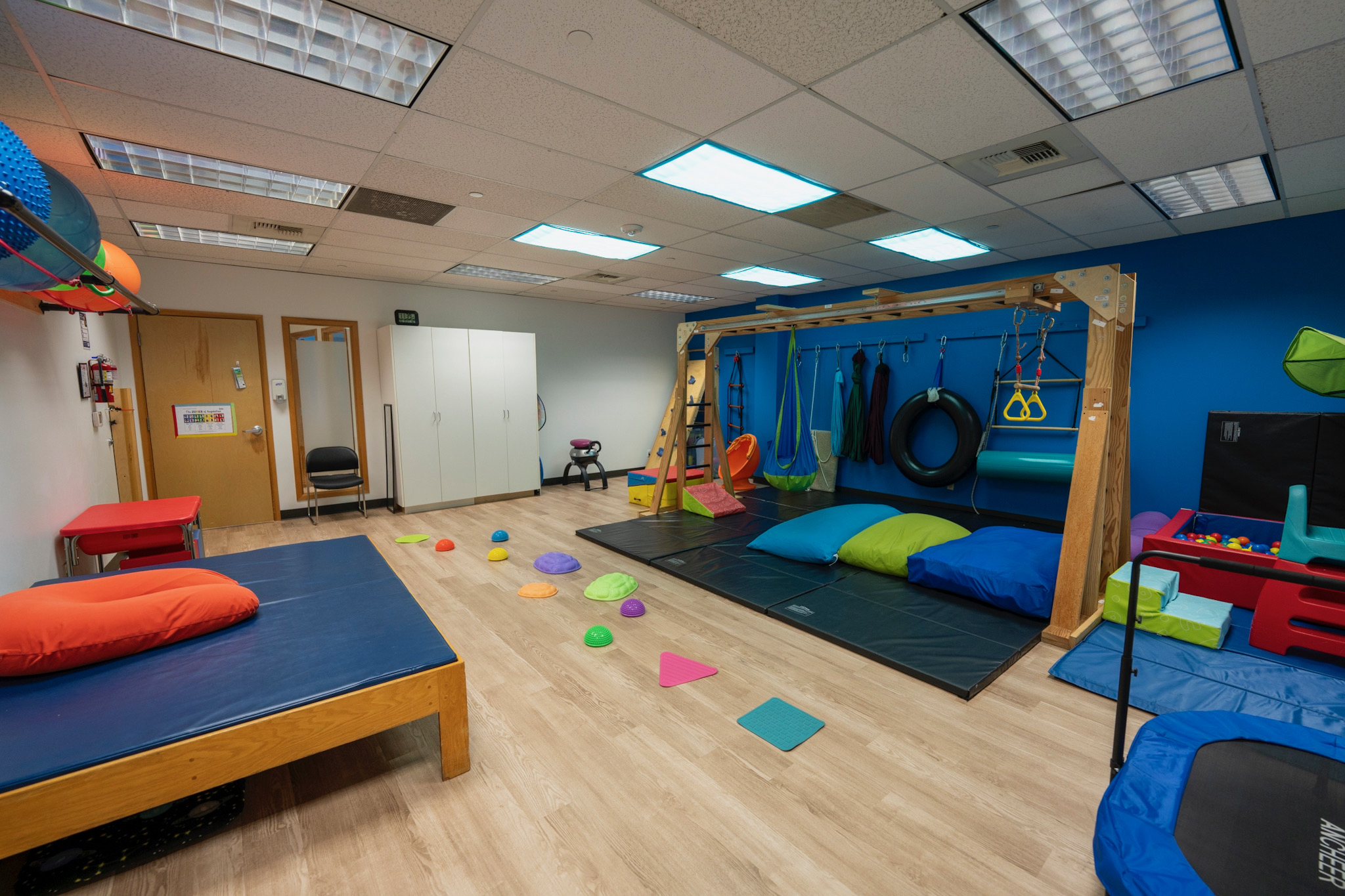
Learn About Our State-of-the-Art Equipment
At our Pediatric Therapy Center in Lynnwood, WA, we choose tools based on your child’s goals and tolerance, and we pair them with task‑specific practice. NMES/FES has robust pediatric evidence, Spider Cage has growing randomized data, TheraSuit® is widely used in intensives, and while formal research is limited, DMI is promising, so we integrate it thoughtfully alongside well‑supported therapies.¹²³⁴⁵⁶
TheraSuit®
A lightweight, wearable suit with elastic bands that helps align the body, improve posture, and provide gentle resistance, so kids can practice better movement patterns during therapy.⁵
We utilize it to:
- Enhance postural alignment, balance, and gait
- Strengthen while practicing real‑life movements (standing, stepping, reaching)
- Pair with Spider Cage during intensives for comprehensive support⁵
Scientific rationale:
TheraSuit combines external alignment with task‑specific strengthening to reinforce more efficient motor patterns during intensive practice, a strategy used in pediatric programs that incorporate suit therapy and the Universal Exercise Unit.⁵⁷
Spider Cage (Universal Exercise Unit / UEU)
A three‑sided frame with bungees and pulleys that provides body‑weight support and graded resistance, letting children safely explore movements (sit‑to‑stand, kneeling, stepping) with independence and confidence.⁷
We utilize it to:
- Unweight early standing and stepping
- Target muscle groups in gravity‑eliminated positions
- Practice dynamic balance and transitions (e.g., quadruped → kneeling → standing)⁸
Scientific rationale:
By reducing gravitational load and delivering graded, task‑oriented practice, Spider Cage protocols have shown significant improvements in balance and motor control compared with conventional therapy in randomized trials and evidence reviews.²³
Dynamic Movement Intervention (DMI)
A structured approach that provokes active motor responses against gravity through rapid transitions and graded supports, aiming to stimulate neuroplasticity and progress toward milestones.⁹
We utilize it to:
- Boost postural control, balance reactions, and alignment
- Engage children with high‑challenge, high‑repetition tasks
- Complement intensives and tools like TheraSuit® and Spider Cage¹⁰
Scientific rationale:
DMI is grounded in motor learning and neuroplasticity principles, using high‑challenge, repetitive tasks to strengthen automatic postural responses, though formal empirical evidence is still limited compared with established modalities.⁹¹¹
NISEstim (Neuromuscular Electrical Stimulation) & Functional E‑Stim (FES)
Gentle, surface electrodes deliver small electrical pulses to activate target muscles; NISEstim builds strength and reduces atrophy, while FES coordinates stimulation during a task (like grasping or dorsiflexing in swing) to retrain functional movement.¹²
We utilize it to:
- Improve selective muscle activation when voluntary movement is difficult
- Augment gait practice (e.g., ankle dorsiflexion during swing) and upper‑limb tasks
- Reduce atrophy and support local circulation¹²¹³
Scientific rationale:
In pediatric populations, especially children with cerebral palsy, gait‑specific NMES/FES consistently improves ankle dorsiflexion kinematics, and meta‑analyses show gains in upper‑limb strength and function when combined with therapy.¹³¹⁴
References
- NSUWorks (2025 RCT): Spider Cage improved standing balance vs. conventional therapy in children with spastic diplegic CP.
Reference - International Journal of Science & Healthcare Research (2021 Review): Evidence‑based review of Spider Cage (UEU) for motor function/balance in CP.
Reference - Johns Hopkins All Children’s (Program Page): TheraSuit® intensive program structure and goals; use with UEU.
Reference - TheraSuit Method – UEU Info: Description of UEU (Spider Cage) and suit therapy integration.
Reference - DMI Therapy (Official Site): DMI overview, principles, and intended outcomes.
Reference - Intensive Therapy Australia (2025 Evidence Commentary): Notes limited formal empirical evidence for DMI to date.
Reference - Frontiers in Neurology (2019 Scoping Review): Gait‑specific NMES in CP—strong evidence for improved dorsiflexion and gait parameters.
Reference - Am J Phys Med Rehabil (2023 Meta‑analysis): NMES improves upper‑limb function, strength, and reduces spasticity in CP. (PDF mirror)
Reference - Cerebral Palsy Guidance (2025 overview): Parent‑friendly explanation of FES with pediatric outcomes summary.
Reference