
Home & Community
Rehabilitation Wherever Life Happens
Recovery doesn’t stop when therapy ends, and it shouldn’t be limited to a clinic. At Rehab Without Walls, our Home and Community neuro rehabilitation program brings expert, interdisciplinary care directly to the places where life happens most. Whether therapy takes place at home, school, work, or in the community, we tailor every treatment plan to help patients build the skills and confidence needed to regain independence in everyday life.
Practicing daily activities in familiar settings often increases motivation, encourages lasting progress, and helps reduce the risk of setbacks or injuries. For more than 30 years, we’ve helped thousands of adults and children achieve meaningful outcomes through our home and community-based rehabilitation programs, with results published in numerous peer-reviewed medical journals.
Our interdisciplinary team works closely with patients, families, and caregivers throughout the rehabilitation journey. Every step of the way, we are there to provide personalized support, education, and guidance. This collaborative approach helps build confidence, promote independence, and prepare patients for long-term success in their everyday environments.
Is Home and Community Neurorehabilitation the Right Fit?
Home and community rehabilitation is best suited for individuals who:
- Are medically stable and ready to continue rehabilitation at home
- Have the appropriate support for a safe transition to home and/or have limited access to transportation to facility-based programs
- Will experience a clinical advantage from practicing functional skills in their own home, school, workplace, or community environment
Our Home and Community neuro therapy programs are covered by some commercial insurance plans and workers’ compensation. Medicare does not cover home and community-based rehabilitation.
Features of Our Care Team
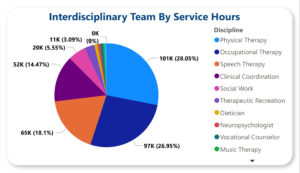
A home and community care team may include experts from the following therapy disciplines:
- Physical, occupational, and speech therapy
- Recreational therapy
- Psychology & neuropsychology
- Dietitian
- Licensed clinical social worker and clinical counseling
- Clinical coordination
- Music therapy
- Vocational therapy
- Special education tutors
Our Approach
Unlike traditional home health therapy, our program is designed for individuals who need more intensive, specialized care. Patients do not have to be homebound to receive services and may receive anywhere from 10 to 25 hours of personalized therapy each week.
Every treatment plan is built around the individual’s goals, daily routines, and the activities they enjoy. Instead of practicing tasks in a staged setting, patients can develop skills in the places they will actually use them. That could mean shopping at a local grocery store, preparing meals in their own kitchen, safely navigating their home, or returning to work/school with greater confidence. Focusing on real-life experiences makes therapy feel more practical, relevant, and meaningful.
Before therapy begins, our interdisciplinary team conducts a comprehensive evaluation to understand each patient’s needs and develop a personalized treatment plan. We evaluate each patient’s home environment, safety needs, existing equipment, and available support systems. We also consider personal factors such as communication, learning preferences, cultural beliefs, and daily routines to develop an effective treatment plan.
A home safety evaluation is an important part of this process. During a one- to two-hour assessment, our team evaluates:
- Fire hazards
- ADA specifications for wheelchair-bound individuals (ramps, door widths, etc.)
- Safe emergency exit routes
- Opportunities to improve independence through bedroom, bathroom, and kitchen modifications
- Potential fall hazards (flooring, furniture, rugs, etc.)
- Stair safety and accessibility
- Any existing adaptive equipment and recommendations for upgrades
- Outdoor terrain and accessibility around the home
2024 Home & Community Rehabilitation Program Outcomes
Rehab Without Walls® Home and Community rehab blends evidence-based therapies with creative uses of the patient’s own surroundings – whether at home, school, work, or in their own community.
Addressing goals and barriers in real-life settings can increase motivation, lead to more durable outcomes and reduce the risk of injuries that could lead to rehospitalization.
Outcomes are important indicators of a program’s success. At Rehab Without Walls, we use outcomes to measure our effectiveness in helping people improve their quality of life and return to independent living after an injury or illness.
2024 Patients Served

Mayo Portland Adaptive Inventory (MPAI-4) and Supervision Rating Scale (SRS)
The MPAI-4 assesses how well a person is doing after an acquired brain injury. It measures the areas of ability (physical and cognitive skills), adjustment (anxiety and depression) and participation (social interaction and self-cares). The lower the score, the higher the level of independence. Our goal is to make at least a 5-point change from admission to discharge.
And the SRS describes someone’s ability to be home alone without assistance. While any level of improvement in independence can be meaningful to a patient and their support system, our goal is to help our patients be home alone for 8 hours or more by discharge. We compare scores taken at admission, discharge, 3 months after discharge and 1 year after discharge.

MPAI Chronicity
MPAI Chronicity shows improvement across length of time from when the injury or illness happened and when the patient was admitted to Rehab Without Walls. This can show the ongoing success of the rehabilitation process, even years after the injury.
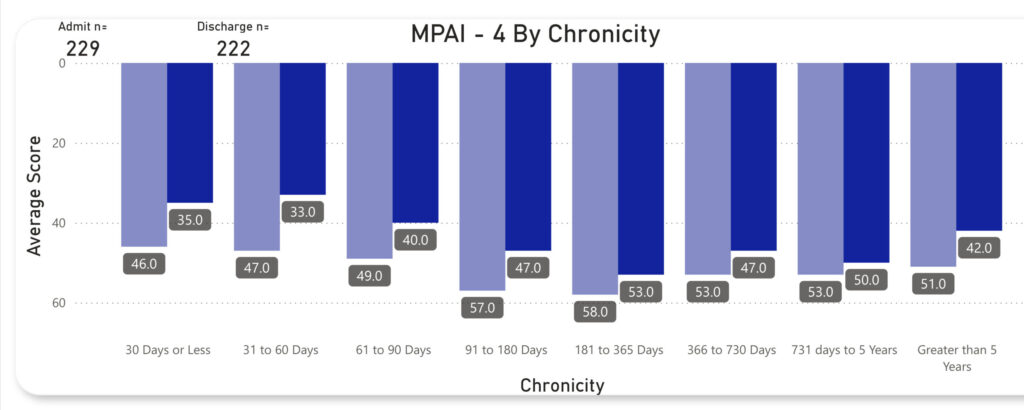
The earlier RWW Home and Community begins services from injury the greater the results. RWW continues to see improvement greater than 5 years post injury.


2024 H&C Spinal Cord Injury Specialty Program Outcomes
Outcomes are important indicators of a program’s success. At Rehab Without Walls, we use outcomes to measure our effectiveness in helping people improve their quality of life and achieve the maximum level of independence after spinal cord injury or disease.

Supervision Rating Scale (SRS) describes someone’s ability to be home alone without assistance. While any level of improvement in independence can be meaningful to a patient and their support system, our goal is to help our patients be home alone for 8 hours or more by discharge. We compare scores taken at admission, discharge, 3 months after discharge and 1 year after discharge.

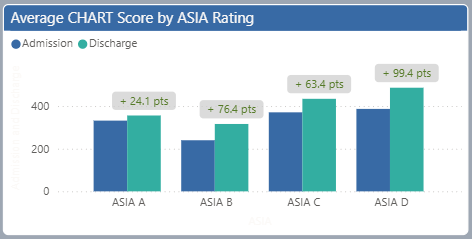
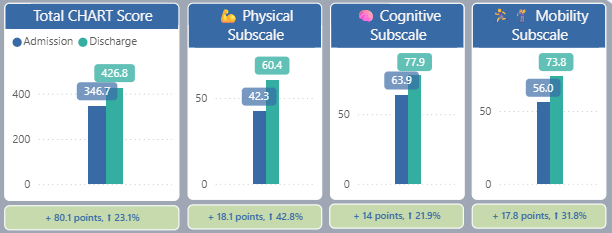
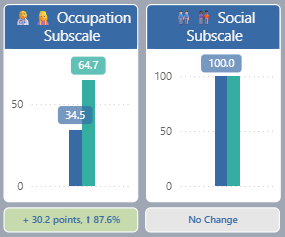
Craig Handicap Assessment & Reporting Technique (CHART) measures the total impact of spinal cord dysfunction on return to life roles. This includes physical independence (how much help is needed for everyday activities like getting out of bed, getting dressed, using the restroom, and making simple meals), mobility (ability to access both home and community environments, including getting out of bed, getting out of the house and staying away for the night), occupation (return to productive activity including work, school and homemaking) and social interaction (participating in and maintaining relationships). A higher score indicates a higher level of independence. Scores are compared at admission, discharge, 3 months after discharge and 1 year after discharge.